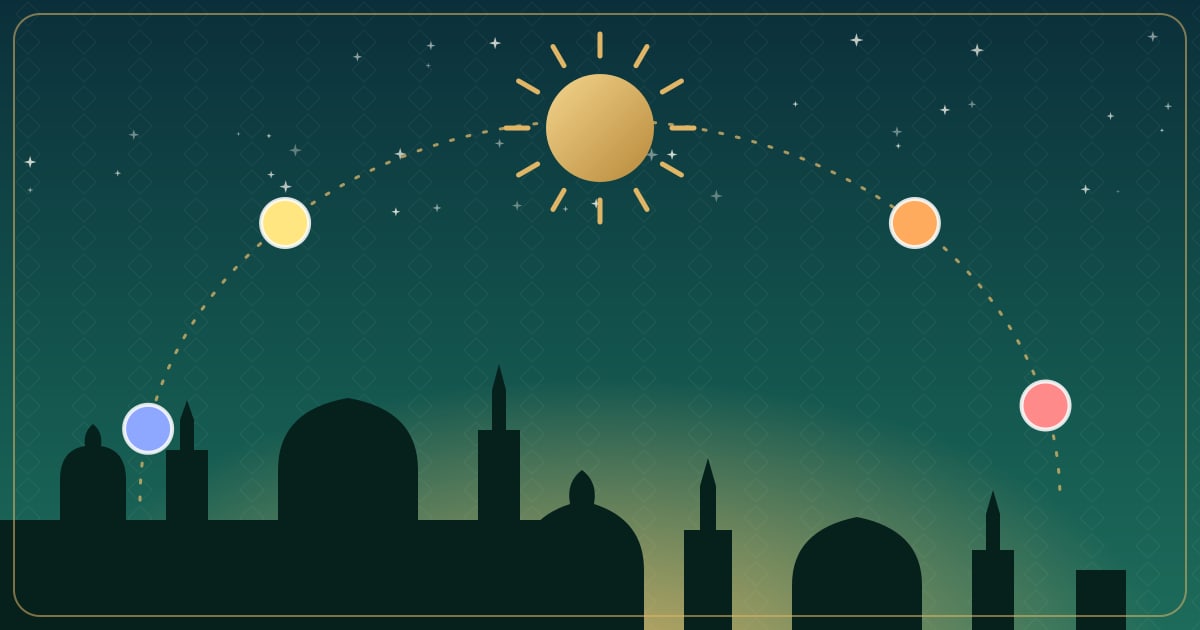
Prayer times are calculated from the position of the sun at your exact location. Dhuhr starts after the sun passes its highest point, Asr when a shadow reaches a set length, Maghrib at sunset, and Fajr and Isha when the sun is a set number of degrees below the horizon. The angles used for Fajr and Isha depend on the calculation method, which is why two sources can differ by a few minutes.
You can see the times for your city in our prayer times by country, and each page tells you which method it uses.
The five prayers and the sun
Islamic prayer times come from the Quran and the Sunnah, which tie each prayer to a natural sign. Astronomy converts these signs into clock times for any date and place.
- Fajr begins at true dawn, when a thin line of white light spreads across the horizon, and ends at sunrise.
- Dhuhr begins just after the sun passes its zenith (solar noon) and starts to decline. It ends when Asr begins.
- Asr begins when the shadow of an object reaches a given length, and it ends at sunset.
- Maghrib begins at sunset, when the sun's disc has fully set, and lasts until the red twilight disappears.
- Isha begins when the twilight has faded and the sky is dark, and lasts until Fajr, or up to midnight in the preferred opinion.
Sunrise (Shuruq) is not a prayer, but it marks the end of Fajr time. Voluntary prayers are discouraged while the sun is rising, at its highest point and setting, so sunrise matters even though no prayer starts then.
How each time is calculated
Fajr and Isha: the twilight angles
At dawn and dusk the sky is lit before the sun rises and after it sets. Astronomers measure this twilight by the angle of the sun below the horizon. Fajr is when the sun is a given angle below the eastern horizon in the morning, and Isha is when it reaches a given angle below the western horizon at night.
The correct angle is a matter of scholarly and scientific discussion, so organisations use slightly different values. Common ones are 15 to 19.5 degrees for Fajr and 15 to 18 degrees for Isha. A bigger angle means an earlier Fajr and a later Isha.
Dhuhr: solar noon
Solar noon is the moment the sun crosses your meridian. Dhuhr time is solar noon plus a small margin, usually a minute or two, so that the sun has clearly begun to decline. The time depends on your longitude and the date.
Asr: two shadow rules
Asr starts when an object's shadow reaches a defined length plus its noon shadow:
- Standard (Shafi'i, Maliki, Hanbali): shadow equals the object's height.
- Hanafi: shadow equals twice the object's height, which gives a later Asr.
Most apps let you choose. The Hanafi time is often 30 to 60 minutes later in the afternoon.
Maghrib: sunset
Maghrib is calculated from the sunset time, when the upper edge of the sun disappears, adjusted for atmospheric refraction. Some methods add a small safety margin of a minute or two.
Calculation methods compared
Different organisations publish their own angles. These are the methods used on this site (each country page says which one applies):
- Muslim World League (MWL): Fajr 18 degrees, Isha 17 degrees. Widely used in Europe, the Far East and parts of the US.
- ISNA (Islamic Society of North America): Fajr 15 degrees, Isha 15 degrees. Common in the US and Canada.
- Umm al-Qura University, Makkah: Fajr 18.5 degrees, Isha a fixed 90 minutes after Maghrib. Used in Saudi Arabia.
- Egyptian General Authority of Survey: Fajr 19.5 degrees, Isha 17.5 degrees. Used in Egypt, Syria, Lebanon and parts of Africa.
- Gulf Region: Fajr 19.5 degrees, Isha 90 minutes after Maghrib. Used in the Gulf states.
If you are not sure which method to use, choose the one used by your country or the local mosque. Praying with the congregation at the times your mosque announces is the practical rule, since a few minutes of difference between methods does not change the validity of the prayer in most cases.
Why do prayer times differ between apps and websites?
- Different methods. MWL and ISNA, for example, differ by a few minutes at Fajr and more at Isha.
- Different Asr rules. Standard and Hanafi Asr can differ by half an hour.
- Safety margins. Some sources add a few minutes (ihtiyat) to Fajr, Dhuhr or Maghrib to be sure the time has entered.
- Rounding and location. A city centre point is used, so a suburb 30 km east sees the sun earlier. The time changes by about four minutes per degree of longitude.
- Daylight saving time. Clocks move one hour in many countries, and all times shift with them.
For everyday use, any reputable source using the method your community follows is fine. If a time is unusually far from the mosque's timetable, check the method and Asr setting first.
High latitudes: when the sky never gets dark
In summer at far northern or southern latitudes (above about 48 degrees, for example much of the UK, Scandinavia and Canada), the sun may never go deep enough below the horizon for the twilight to end, so true Fajr and Isha may not occur. Councils offer several solutions:
- Middle of the night: the night is divided and Fajr and Isha are fixed relative to it.
- One-seventh of the night: Fajr starts in the last seventh of the night and Isha after the first seventh.
- Angle-based: a limit is placed on the angle used.
- Nearest city: use the times of the closest place where the signs occur.
If you live in a high-latitude region, follow the decision of your local mosque or council.
How accurate are online prayer times?
The astronomy is precise to within a minute. The difference between sources is mostly the method choice, not an error. Our times use a trusted calculation service and show the method and angles on each country page, so you can see exactly how your times were calculated. Compare the prayer times in Algeria with Saudi Arabia and you will see the different methods used.
To find the direction to face once the time enters, use our guide to finding the Qibla, or the Qibla compass.
Frequently asked questions
How are prayer times calculated?
From the sun's position for your latitude and longitude on a given date. Dhuhr follows solar noon, Asr uses shadow length, Maghrib is sunset, and Fajr and Isha use the sun's angle below the horizon.
Which prayer time calculation method is most accurate?
No single method is the most accurate, because the Fajr and Isha angles are matters of interpretation. Use the method followed by your local community or the mosque you pray in.
Why is my Fajr time different on two apps?
Each app may use a different Fajr angle (15, 18 or 19.5 degrees), so the time can differ by 10 to 25 minutes. Safety margins add to the difference.
What is the Hanafi Asr time?
When an object's shadow is twice its height plus the noon shadow. It is later than the standard time.
Do prayer times change every day?
Yes. The sunrise and sunset move through the year, and the change is largest in the spring and autumn at higher latitudes.
Times on this website are calculated and may differ by a few minutes from your local mosque. Always follow the timetable of your local community when it differs.